A Feminist Interdisciplinary Investigation into the Impact of the Moving Pieces Collective Approach to Managing Medically Unexplained Symptoms

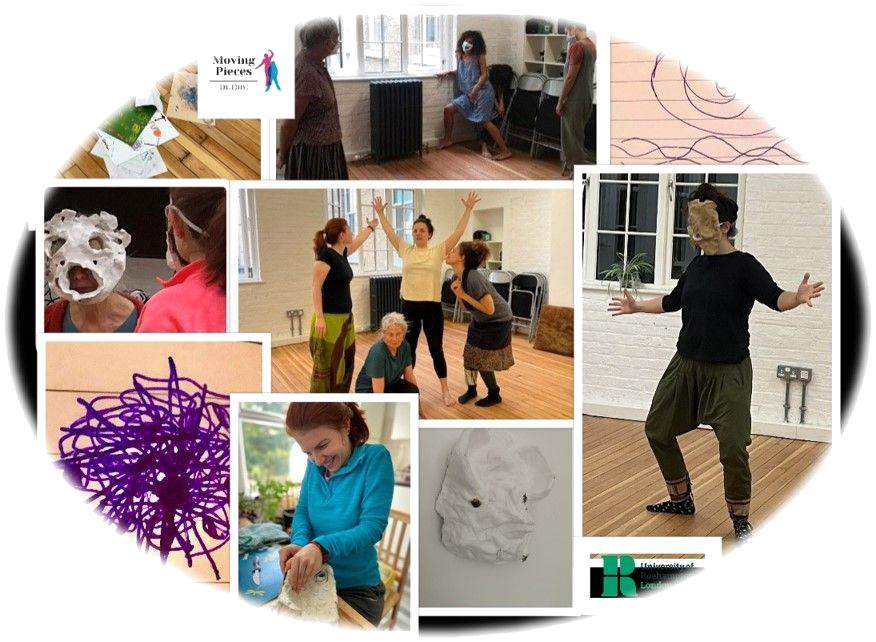
This interdisciplinary arts-science research project was conducted from a feminist embodied perspective (Allegranti 2024, 2019, 2013, 2011). The research was commissioned by Moving Pieces Collective and conducted by me, a research student in the dance and psychology departments at the University of Roehampton since 2019. Moving Pieces Collective is an art in health theatre organization founded and directed by Charlie Blowers, an experienced art psychotherapist, clinical supervisor, Feldenkrais practitioner, and artist. The Blowers’ approach is to better understand the diverse experiences of those living with medically unexplained symptoms by embracing the relationship between the arts and sciences. This research project explored the impact of the Moving Pieces Collective approach (Blowers, 2023) and argued that the integrative approach aimed to support people living with medically unexplained symptoms by developing their awareness and self-regulation skills and, thus, improving their quality of life and challenges the dominant view of the Western medicine. 

References:

Allegranti, B. (2024) Moving Kinship: Practicing Feminist Justice in a More-than-Human World. London/New York: Routledge. Available at doi.org/10.4324/9781003029045

Allegranti, B. (2019) Moving Kinship: Between Choreography, Performance and the More-than Human In Thomas, H. and S. Prickett (ed.) The Routledge Companion to Dance Studies 1st Edition. [Kindle Edition] New York: Routledge

Allegranti, B. (2013) ‘The politics of becoming bodies: Sex, gender, and intersubjectivity in motion’, The Arts in Psychotherapy, 40, pp. 394 – 403

Allegranti, B. (2011) Embodied Performances: Sexuality, Gender, Bodies. [Kindle Edition] Basingstoke: Palgrave Macmillian.

Blowers, Ch. (2023) `The Moving Pieces Approach: Poetic Space, Embodied Creativity, Polarity, and Performance as Aspects of Aesthetic Experience` in Poltrum, M., Musalek, M., Kathleen G. and Saito, Y. (ed) The Oxford Handbook of Mental Health and Contemporary Western Aesthetics, Oxford University Press. Available at: doi.org/10.1093/oxfordhb/9780192866929.001.0001

Dance Movement Psychotherapy in a second language:

An embodied phenomenological investigation

In 2015 my postgraduate dissertation was a phenomenological investigation aimed to explore how dance movement psychotherapists experience using English as a second language in the therapeutic space. My interest in this research topic emerged from my autobiographical experience, from my experience of noticing the difference in myself and in my body using English as my second language and using Hungarian as my
native language. Drawing from the phenomenological stance I conducted semi-structured interviews and asked for embodied movement responses of four dance movement psychotherapists, who trained and facilitated dance movement psychotherapy in English as their second language. Through the emerged themes
I believe that this phenomenon is relevant to dance movement psychotherapists and important to draw attention to the lived experience of using a second language in therapeutic space. In addition dance movement psychotherapy, as an approach
can facilitate finding a way to meet the different languages and the different language-related experiences.

Body-image Examination Program- A new diagnostic tool

Between 2006 and 2008  with my peer and friend, Katalin Lantos we created and conducted research with a new diagnostic tool to measure body-image, which contained all those aspects that were missing in other body image diagnostic tools.  Our research was to compare the Body-image Examination Program developed by us with Fallon-Rozin Test. The Body-image Examination Program is a computerized instrument that helps in recognizing body-image disorders. The basis of this is the Fallon-Rozin Test with the main difference that while in the Fallon-Rozin Test subjects can choose from whole figures, in the Body-image Examination Program they can choose and assemble the appropriate figure from different parts of the body.  We presented our research and gained the 1st price at several student conferences. However, we could not develop further our Program due to a lack of financial funding.

Publications:

Katalin Lantos, Eszter Ivan, Bea Pászthy dr: The body image and its measurements. In: Ferenc Tury, Bea Paszthy (editors) (2008): Eating and body image disorders. Pro Die , Budapest

Eszter Ivan, Katalin Lantos: „The Body Image Program” in D., Nemeth, A., Krajcsi, A. Szokolszky (editors): Essays of Psychology in Szeged – 2006. JGYTFK KIADO, SZEGED, 2007

My interest in research

Body-image diagnostic tools, delivering dance movement psychotherapy in a second language, and managing medically unexplained symptoms through creative movement.

Early research

My research interests have developed through a continuing exploration of the body as a source of experience, knowledge, communication, and transformation.

Across my research, I have been particularly interested in how embodied experiences that may be difficult to articulate verbally can become visible, meaningful, and accessible through interdisciplinary forms of inquiry.

My early research, between 2006 and 2008 focused on body image and embodied perception, through the development of the Body-image Examination Program, in collaboration with my peer and friend Lantos Katalin, a computerised diagnostic tool designed to explore body-image experience in greater complexity. This work initiated my interest in bringing psychological inquiry into dialogue with innovative methods of examining embodied experience.

Publications: Lantos, K., Iván, E., and Pászthy, B. (2008). A testkép és mérése [Body image and its measurement]. In F. Túry & B. Pászthy (Eds.), Evészavarok és testképzavarok [Eating disorders and body image disorders]. Budapest: Pro Die Kiadó.

Iván, E., & Lantos, K. (2007). A Testképvizsgálati Program [The Body Image Examination Program]. In D. Németh, A. Krajcsi, & Á. Szokolszky (Eds.), Szegedi Pszichológiai Tanulmányok 2006 [Szeged Studies in Psychology 2006]. Szeged: JGYTF Kiadó.

Shifting focus

During my postgraduate training in dance movement psychotherapy, this interest shifted towards the lived and relational body.

My 2014-2015 phenomenological research, Dance Movement Psychotherapy in a Second Language: An Embodied Phenomenological Investigation, explored how dance movement psychotherapists experience working therapeutically in a language other than their native language.

Informed by my own embodied experience of moving between Hungarian and English, the study combined verbal interviews with embodied movement responses, deepening my interest in how the body communicates experiences that language alone may not fully capture.

These strands came together and expanded in my doctoral research (2019–2025), A Feminist Interdisciplinary Investigation into the Impact of the Moving Pieces Collective Approach to Managing Medically Unexplained Symptoms.

Here, my research developed into an interdisciplinary, practice-based approach bringing psychology, dance movement psychotherapy, embodied and artistic practice, feminist new materialist theory, and physiological investigation into conversation.

Working collaboratively with people living with medically unexplained symptoms (MUS), I explored embodied experience through movement, artistic and performative practices alongside qualitative inquiry, interoceptive awareness and heart rate variability.

Moving with interdisciplinarity

This research was commissioned by Moving Pieces Collective (MPC), founded and directed by Charlie Blowers, an experienced arts psychotherapist, clinical supervisor, Feldenkrais practitioner, and theatre artist.

Blowers facilitated the practice-based aspect of the research, in which four people living with medically unexplained symptoms (MUS) and I, as the researcher-practitioner formed a group.

Between 2019-2025, I, as a research student, psychologist and dance movement psychotherapist, conducted the research under the supervision of Dr Beatrice Allegranti, and Dr Leigh Gibson.

Across this professional and research journey, my central interest has remained the relationship between body, mind, language, creativity, and ways of knowing.

My current research interests continue to explore how embodied and artistic practices can contribute to health and wellbeing, particularly by making space for complex experiences that may remain invisible, marginalised, or insufficiently represented within conventional biomedical approaches.

Publications: Coming soon.

My services

Creative & Embodied Psychotherapy

Moving beyond traditional talk therapy to integrate mind, body, and creative expression for deeper healing

Embodied & Relational Supervision

Supporting practitioners in deepening their embodied and relational presence and wisdom

Workshops

Body-centered, creative spaces to explore movement, personal awareness, and collective connection

Family Constellations & Beyond

Moving through the fields, offering an integrative approach applying principles of family constellation theory, neuroscience and universal consciousness (quantum field).